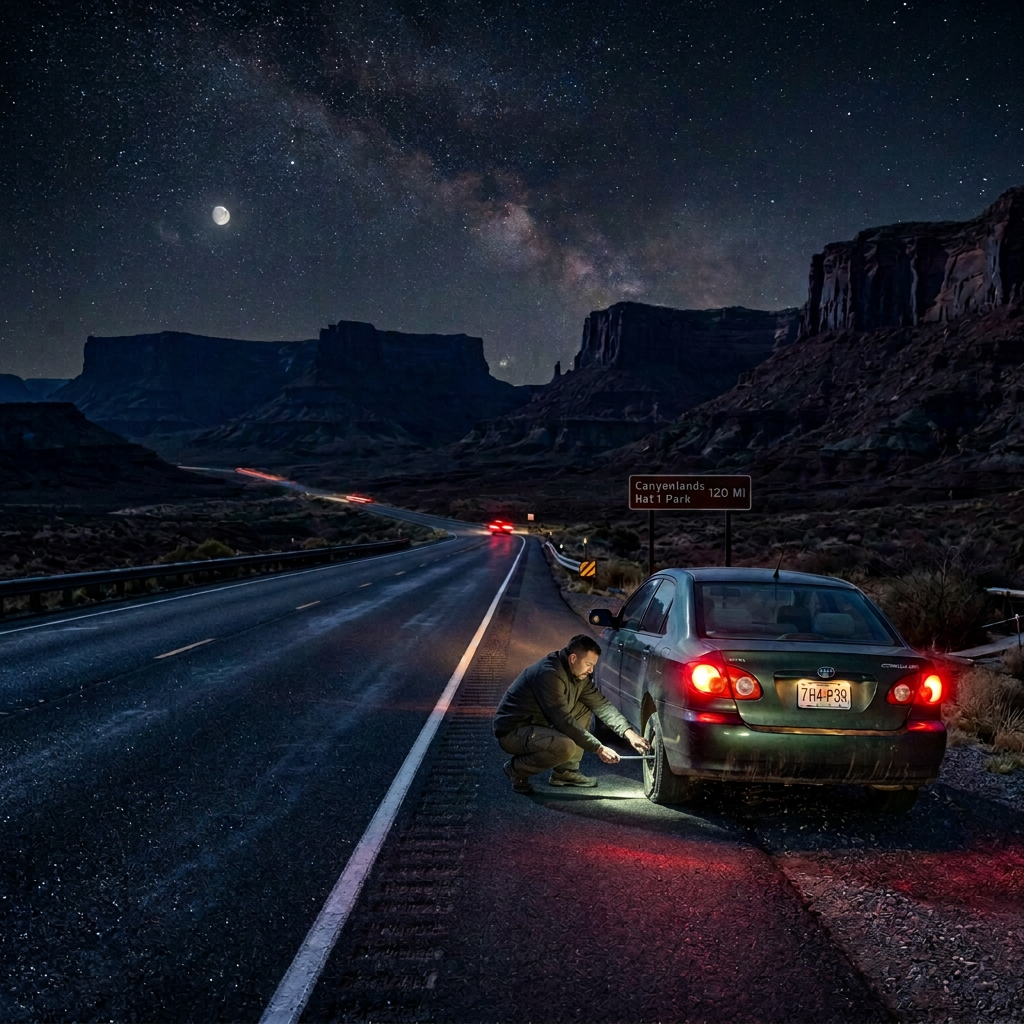
At fifty-two, Birk, on a rare impulse, decided he deserved to take several sick days to finally go on a road trip and see what lay just beyond the busy lights of Salt Lake City. The desert Canyonlands and his old college gang were the last itch of an early midlife crisis. It would be a brief, low-key adventure, he reasoned, so he replied “Yes” to the text invitation. But this current situation, in the middle of his journey, wasn’t part of the plan: the flat tire and the delay in fixing it. He observed the two-lane highway as he took the spare tire out of his trunk. About half an hour later, he was almost done lowering the jack when he heard solid footsteps on the loose gravel as the large stranger drew closer beside the rear passenger side of the green sedan.
Birk spoke rapidly, betraying himself, as his worries ran over what the stranger’s reason was for stopping off to the shoulder of the road. However, he had gotten out of a tow truck. He looked at him carefully, then ahead, at the dimly lit parking lot about a quarter-mile away. Some more doubts crept inside as he considered that the stranger might be trouble. He scratched his dirty chin from the drips of mayo and mustard on his fast-food burger run at the start of his trip, and shook his shoulders instinctively to project himself bigger than he was.
He couldn’t smell the many eucalyptus trees, which he saw only as black traces, scattered across a patch of the highway that had flattened his tire. The woods whispered with the stumbles of wild animals seeking shelter within the trees, in the absence of caves.
“Hey, you need some help? A flashlight glowed, its beam directed at his face. “People often get stranded on this highway leading straight up there into the Canyonlands. The stranger pulled his hands from his trucker jacket and put them on his belt; they were big. “I don’t get why rich folks fancy they are not ready for the painful lashes of the desert’s harsh conditions.”
Birk stood up after tightening the last bolt of the changed tire. The stranger was 6-foot-6; he couldn’t win any fight; he calculated he would lose terribly, which he had no intention of doing. “Well, there’s nothing weird about appreciating camping and hunting by the river, just some things to do in the general outdoors, folks tired of boredom, I guess.” He failed to crack the stranger’s frozen stare as he unwrapped a beef jerky.
“Well, let me tell you, the desert has serious traps that can flip those interests fast. You listen to the news and gossip going around about the canyonlands being overtaken by gray wolves and a serial killer.”
“Not fond of gossip. The fact is, it would be extremely rare to run into either one. Just glad the odds are better that you happened to come by now. Birk took out his cell phone; “The service is crap here. Is there a gas station nearby? The gas tank is almost empty; forgot to fill up after leaving.”
“Even if you managed a call, nobody’s coming anytime soon by chance with a filled gas can. Can I give you a ride? You won’t make it to an open gas station. The stranger chewed as he said, “Offer is free, alright.” He swallowed. I am off duty and headed to leave my tow truck at one of the business yards. No extra expense to get you farther away or closer to Salt Lake City? Whatever you like? Considering It’s already really late and rather dark to be stuck out here. And there’s plenty of space for your backpack, lantern, tent, and other trail gear.”
“Fine. You can drop me off at the Canyonlands and the main trailhead. I measured the dangers out in the Canyonlands. Seems not for the highway, Birk tensely laughed: I packed batteries, a knife, and a gun for charging wolves or mountain lions.” He didn’t have a gun, but the stranger appeared to take it for truth.
“Next time have your college reunion in western Utah; the woodlands are safer. Mountains shield you from any bad weather better than the canyons.” Mother Nature is a ruthless force you don’t want to ever reckon with.” The stranger said as he turned toward his tow truck. “Let me take you back to the lit-up city, and wife? No worries, Birk said, looking at his car, which had fewer than 15 or 20 miles of fuel. “I can lift your car and park it over there.” The stranger washed clean the problem and pointed to the dimly lit parking lot a short distance away.
The stranger wore a long-sleeved plaid shirt coat and pale jeans. Birk grabbed his things from the backseat, strapped his backpack on, and followed the stranger back to the tow truck. “A bowl of hot soup, an electric fireplace, and the familiar comforts of home are what I already miss, but I promised my friends that I would make this college reunion,” Birk replied.
The stranger unhitched the traveler’s car at the back of the parking lot; Birk rolled up the sedan’s windows, and he noticed the disquiet, isolation, and darkness.
“I promised to meet up with friends I haven’t seen in a decade. Hey, where’s your tow truck business at?” His eyes crinkled deep, then relaxed a little; eyes like glass dimmed with some apprehension. No looking backward or forward into the night’s seeded and spooky darkness. He had lived his life up to this point cautiously. Birk thought, I will soon be amongst the friends, all in the same sad, poor state—temporarily deprived of every modern convenience and possession, and utterly unreachable in the Canyonlands.
There was a short silence, and then Birk felt something punch the side of his head. It was the stranger’s satellite radio. The metal corner edge came down awkwardly but very hard, opening the fleshy bag beneath his right eye and cutting vertically to his mouth and chin.
There were instant hoards of memories, crumbs from the past that grew and changed into a ripple, then a wave over his spirit, peeling the darkness, then a kind of weak light it created. Dying was like filing and storing expired dreams. The crumbs of light that were dug up to motivate him to keep going. He had lost his family; mama and papa were cremated and buried, and it was only after a good number of months that he understood that they would not come back. What was left were foolish family heirlooms of every sort and kind.
Birk breathed as deeply as he was capable, the fresh eucalyptus scent surrounding the empty dog park rising gently into the elegant aspen woods. No ghostly mutts were fetching plastic toys inside the dog park, and the parking lot was still, and the dogs were barking as they played, he imagined. Birk could hear the mind’s engine give one last turn toward life rather than death.
Nothing was waiting for him on that highway except darkness and a watchful predator that was worse than the gossip.
His breathing and heart rate dropped like dominoes as the past fell into the present. He was sitting atop the folded blankets of his twin mattress alone in his college dorm. He was reading a comic book, his back leaning against the wall, facing the door out to the hallway. Then, as if time had jumped and paused, the stranger lifted him and threw him at the chain-link fence that separated the dog park from the eucalyptus and aspen woods. When he hit the ground, he landed first on his right knee, and the kneecap popped like a kernel of corn. Sirens could not satisfactorily measure the panic in his screams. Red marks spread like a clumpy grape jam through his pocket T-shirt and grey gym sweater; his own combo knife, the stranger stabbed into his neck, and the flashlight hit his eyes again, no natural fidget in his face.
The night fell silent again until his awful cries filled the void; the middle-aged man’s eyes stung with confusion and terror that tore totally apart his belief in humanity. He was unconscious, running back to the college dorm building, his sneakers slapping on the faux marble floors. He heard the sarcastic voices say how much luckier these scholars were to share a shelter with such prestigious professors as he approached their shared offices.
Birk threw a punch that missed the strangers above the belt. He shut his eyes, his mouth wide, because if he saw anything other than that college main building, he would not understand; instead, he bit down on the collar of his sweater. The earth seemed to quake. Somebody had to have heard him; no, it was impossible to breach the borders of the desert darkness to safety and rescue. He regained his awareness between the gaps of panic, terror, and hell; survival was a cold, jolt-awake. He grabbed a loose grey pole from the corner fence as a weapon. Above, birds and snakes challenged each other, unseen, in the branches of the eucalyptus trees.
There was no one out there to interrupt the punches from the psychopath’s blood-painted satellite radio. Then suddenly he was not there. “Where are you?” Birk held the metal pole, prepared to swing.
The last jogger, bicyclist, and bus tours left hours earlier. He listened to the whispers of the desert interstate, and the wild woods answered with the stranger crouched, studying the curved trails behind the dog park’s barely visited even in calm seasons. The stranger said, “ Your college friends I can help also.” The eucalyptus trees’ branches bent, leaves falling, and the ground was layered with them and glued by sprays of Birk’s blood.
Birk didn’t resist his fate anymore; he listened to the raccoons circling the edges of the woods in search of food. The stranger used strips of eucalyptus bark to camouflage Birk’s body, which he dragged to the back of his tow truck’s hitch and drove on, not stopping, until the brown road sign marking his shelter in the Canyonlands.
There would be more bodies before the Surreal Red Forces or the Scarlet Owl drained the desert’s bloodbath.